

What is CRISPR?
Basic Definition: CRISPR (Clustered Regularly Interspaced Short Palindromic Repeats) is an immune system utilized by microbes to defend against viruses called bacteriophages.
When a virus or other invader enters a bacterial cell, CRISPR functions by incorporating part of the trespasser’s DNA, so that it can find and destroy the virus if it is to enter the cell again.
Components of CRISPR
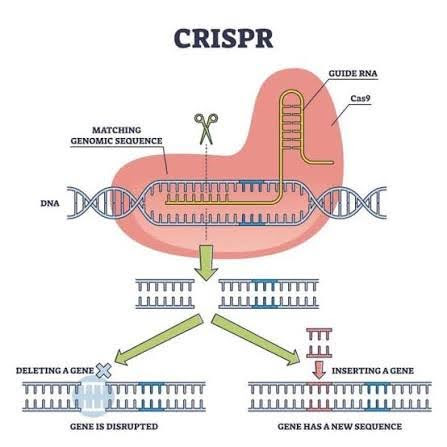
Cas9 Protein: Creates a double-stranded break at the exact location on the DNA sequence that corresponds to the Guide RNA (see below). This allows for genetic editing, as the cell’s repair mechanisms respond to the break in order to fix the cut.
Guide RNA (gRNA): Similar to a GPS system. Guides the Cas9 protein to the specific location on the DNA sequence that needs to be extracted, copied, or edited.
Cellular Repair/Editing After Use of CRISPR Cas9
Non-Homologous End Joining (NHEJ): After the double-stranded break, the cell glues the broken ends of the DNA back together, either with addition (insertion) or removal (deletion) of certain DNA bases at the break site. This creates what are known as indels, disrupting the reading frame of genes.
Homology Directed Repair (HDR): Longer repair process than NHEJ. Scientists may provide a custom DNA template for the cell to follow, which HDR uses to precisely edit the gene. This technique is often utilized in medical treatments.
Process
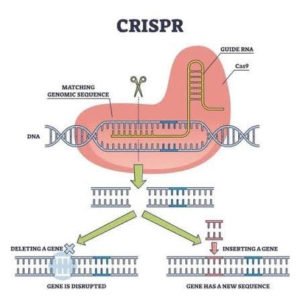
1. Scientists design a specific guide RNA (gRnA) that matches theDNA sequence they want to edit. This binds with the Cas9 protein, which acts as the gene editing tool.
2. gRNA and Cas9 are delivered into the cells.
3. gRNA leads the Cas9 to the exact location that matches the copied sequences.
4. After the targeted area is found, Cas9 makes a precise double-stranded break within the DNA.
5. After the double-stranded break, the cell repairs its own DNA through Non-Homologous End Joining (NHEJ) or Homology-Directed Repair (HDR).
Applications
Medical & Therapeutic:
- Gene Knockouts: By nature of NHEJ’s deletion of DNA bases, CRISPR can often be used to knockout a gene entirely, muting its expression within the organism. This allows for deletion of unwanted mutations.
- Gene Editing: by providing specific DNA templates, scientists are able to tailor DNA sequences in order to correct genetic mutations.
- Gene Activation/Repression: Cas9 has the ability to modulate gene expression, through either amplifying it (activation) or decreasing it (repression). This control in gene activity allows for potential solutions to cognitive disorders.
Agricultural & Food:
- Crop Improvement: By editing genes, scientists have the potential to enhance the yield, nutritional value, and protection against pests/diseases for crops.
- Livestock: By editing genes, scientists have the potential to improve animal health, increase resistance against disease, and increase the productivity of livestock.
Research & Diagnostics:
- Genome Imaging: Field that uses advanced imaging to visualize physical structure/activity of a genome. CRISPR Cas9 based imaging allows scientists to target certain genomic regions with repetitive sequences.
Future/Ethical Implications
By utilizing CRISPR Cas9, scientists are making direct modifications to genetic code. Common ethical concerns arising surrounding CRISPR technology involve the safety of using Cas9 (concerns over off-target mutations), the possibility of eugenics coming into play (scientists ‘engineering’ organisms by favoring desirable traits, and eliminating undesirable characteristics), and justice and equity, given CRISPR treatments are an expensive form of therapy that would not be readily available to all.
