

With how advancements in technology are being applied to the medical field, drug discovery plays a large role in medicine and is therefore changing with the times. The creation of new medicines, research, and data foster the use of technology as it can help the field develop exponentially.
Why machine learning?
Drug discovery is very expensive, time consuming, and has low success rates. It uses strategies that can take around 12 years and over a billion dollars. With drugs developed typically through discovering molecules and targets, machine learning can help make the process much more efficient and less costly.
General Info as to how it plays a part:
Machine learning is used to help with learning about how different chemicals interact, their properties, and its overall success. Multiple different types of machine learning is used and is also applied to traditional methods to all this work to make things more efficient. As a part of machine learning, AI is used heavily in the modern era of drug discovery and research. However, not only AI is used in drug discovery when it comes to machine learning for helping with different aspects of the process.
PROS
Some main parts of drug discovery that ML helps with include:
- Can help with prediction of drug protein interactions
- Predicting drug-protein interactions are important as complications can be found with the drug use, which relies on many unknown interactions. Semi-supervised training techniques should then be used to address these complications with how they also help integrate things like genome data, chemical structure, and drug-protein interaction network data.
- Can help with discovering drug efficacy
- When looking at how drugs work chemically, the results may not always work in therapeutic effectiveness which is the treatment of patients. To help with this, more large scale data needs to be collected when trying to research and understand more about the drugs. For example, microarray data can be found, as it contains much larger sets/amounts of data to use. By applying certain aspects like decision trees and random forest models to create bio marker profiles, machine learning can be used. Additionally, network-based systems can be used to assess the interaction between a disease and the drug target
- Can help ensure safety bio markers
- Bio markers are used a lot to help with safety measures. To overall help with learning more about how drugs act, and their bio markers, deep learning techniques are starting to be used more. This is very important as safety bio markers are looked at ensure the ability of the drug’s use and if there are other complications that may need to be taken into consideration.
- ML helps refine drug candidates through improving bio-activity and chemical structure. This helps scientists optimize and enhance the features and effectiveness of potential drugs to make sure they are the best they can be for use.
- Some extra aspects of drug discovery that machine learning helps improve includes integrating homogenous data sources, accelerating target discovery, and overall helping with more precise results, interpreting outcomes, processing larger data sets, and bias concerns. Clearly showing its impact in drug discovery and the entirety of medicine.
CONS
Some problems that come with ML in drug discovery to be considered are:
- The use of machine learning may be inapplicable when the ML challenges are a large cause in the inability in interpretability outcomes
- There still can be potential biases and risks with AI-driven drug development even though a lot of it is meant to help reduce bias. Therefore needing to rely on progress that needs to be made with scientists, ethicists, and policymakers to ensure the success of ML in drug discovery.
- Some types of ML may not be helpful as certain situations may need more detailed interpretation protocols. This then limits the integration and use of ML in drug discovery as it varies between contexts and the data available.
- With it being a struggle to access high-quality, highly annotated, comprehensible, and diverse data, the development of models and its validation can be skewed. It is a hurdle that can prevent the reliability of AI-driven predictions in the realm of drug discovery.
- The nature of deep learning prevents the work-flow of drug discovery in the real world as it creates barriers that go against troubleshooting and ensuring the validity of different aspects. Models that fail are hard to understand and fix, therefore undermining trust and the potential for integration by other scientists.
TYPES
Some types/examples of machine learning techniques helping with drug discovery:
- Deep Learning
- Deep learning enables complex data models to analyze complex relationships with chemical and biological info – targeting interactions and improving screening methods. This is a very large part of machine learning in drug discovery as it goes beyond GNNs and Transformers. Working more in the sense of a human brain analyzing complex processes, it is stronger and much more useful than basic machine learning algorithms.
- CADD technique
- Computer aided drug design – old technique but one of the first to integrate AI. It at first included QSAR which stands for Quantitative Structure Activity Relationship models. QSAR mainly uses statistics & lays the foundation for more techniques by correlating biological activity and chemical structure related to drug discovery. They also are able to describe compounds by creating molecular descriptions.
- Decision trees & random forest models
- Quickly helps with regression and classification issues as the issues can lead to overfitting and worse outcomes. Where these parts of ML help with accessible data visualization and prevent the overfitting complications. The random forest models take the decision trees (a map out of choices) and then help form accurate predictions and the identification of drug candidates.
- SVM
- SVM stands for Support Vector Machine and predicts the outcome of targeted drugs. Additionally, they are very good with data classifications as well in complex datasets. They can handle non-linear relationships and also find decision boundaries in high dimensional data sets, showing its importance and helpfulness.
- GNN
- GNN stands for Graph Neural Networks and one of its main functions is how it helps with molecular modeling. Molecular modeling is an essential component to drug discovery and GNNs aid in the process tremendously. With its ability to comprehend complex relationships by directly learning from the graph-based molecule structure, GNNs make molecular modeling much easier.
- Transformer architectures
- Transformer architectures first helped a lot with Revolutionized Natural Language Processing and now it also impacts molecular machine learning. Transformer architectures are able to grasp subtle molecular interactions and properties. This is done with by attention mechanisms which then has transformer architectures modeling complex contextual relationships and long-range dependencies
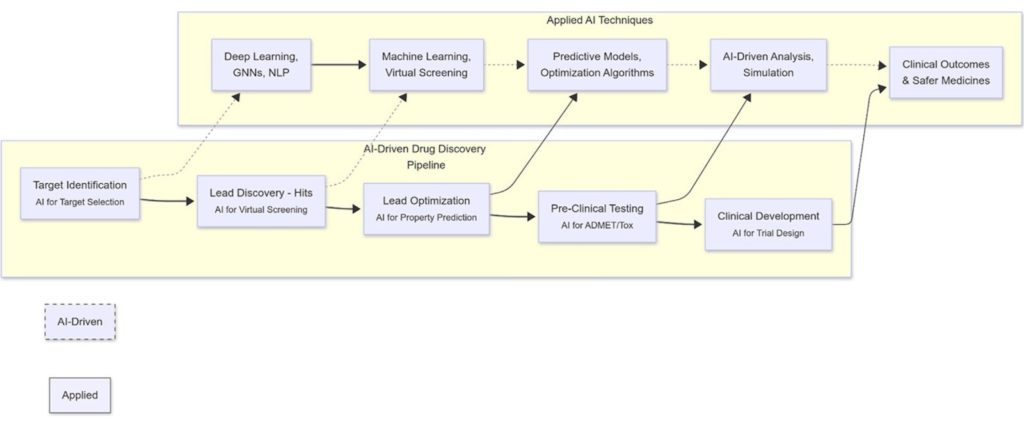
ACS Omega 2025, 10, 23, 23889-23903
Sources:
