

DNA Storage: A technique used to store terabytes worth of information into the 4 DNA nucleotides (A, G, C, T) to represent two-bit binary code (1s and 0s).
- E.g., Guanine (G) would represent [1 0]
DNA has been the preferred method for digital information storage due to its biodegradability and its immense durability. It is much denser and more compact than a solid-state drive, and it doesn’t require nearly as many resources, such as water and electricity. There is also the added benefit that each nucleotide represents two numbers and can accommodate vast amounts of information.
There are six steps to DNA data storage:
- Encoding
- Synthesis
- Preservation
- Retrieval
- Sequencing
- Decoding
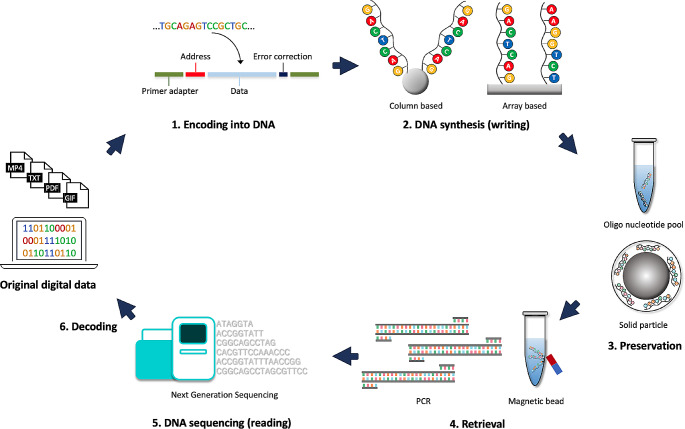
Biomed Eng Lett. 2024 May 3;14(5):993–1009. doi: 10.1007/s13534-024-00386-z
- Encoding
Each nucleotide is defined as a specific two-bit binary code.
- Writing/Synthesis
Strands of DNA are synthesized based on the order of the encoded nucleotides. At certain times, structurally unfavorable orderings of these nucleotides necessitate intervention during synthesis. Synthesis is done in various ways. Inkjet printing involves using tiny droplets of premade DNA fragments that use many, many chemical reactions to elongate the DNA strand. Other methods include using semiconductor chips and silicon wafers to assemble the strands of DNA.
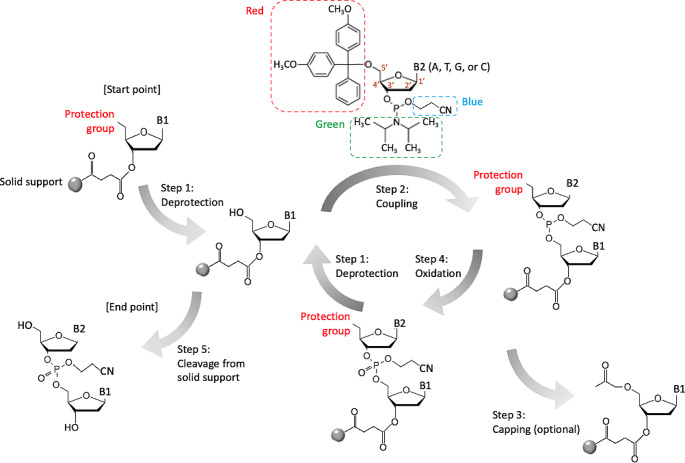
Biomed Eng Lett. 2024 May 3;14(5):993–1009. Doi: 10.1007/s13534-024-00386-z
- Preservation/Storage
DNA must be preserved to prevent degradation. This involves maintaining the right environmental conditions, including pH, temperature, UV radiation, ionizing radiation, and more. Some storage methods have included adding a fluorescent tag to DNA samples so that, when a light is shone on them, the samples can be recognized.
- Retrieval
When retrieving a DNA sample to decode it into digital data, the sample must undergo Polymerase Chain Reaction (PCR) to amplify the amount of DNA and create more fragments for sequencing.
- Sequencing/Reading
Sequencing methods such as Sanger sequencing and Illumina’s Sequencing by Synthesis (SBS) are currently the most popular methods of reading the DNA and encoding its nucleotides. However, while these sequencing techniques are highly accurate, they require significant time due to limitations on read length. Other methods, like nanopore sequencing, which involves having the DNA strand pass through a tiny hole and measuring changes in electrical current, then matching them to DNA nucleotides, have a high error rate.
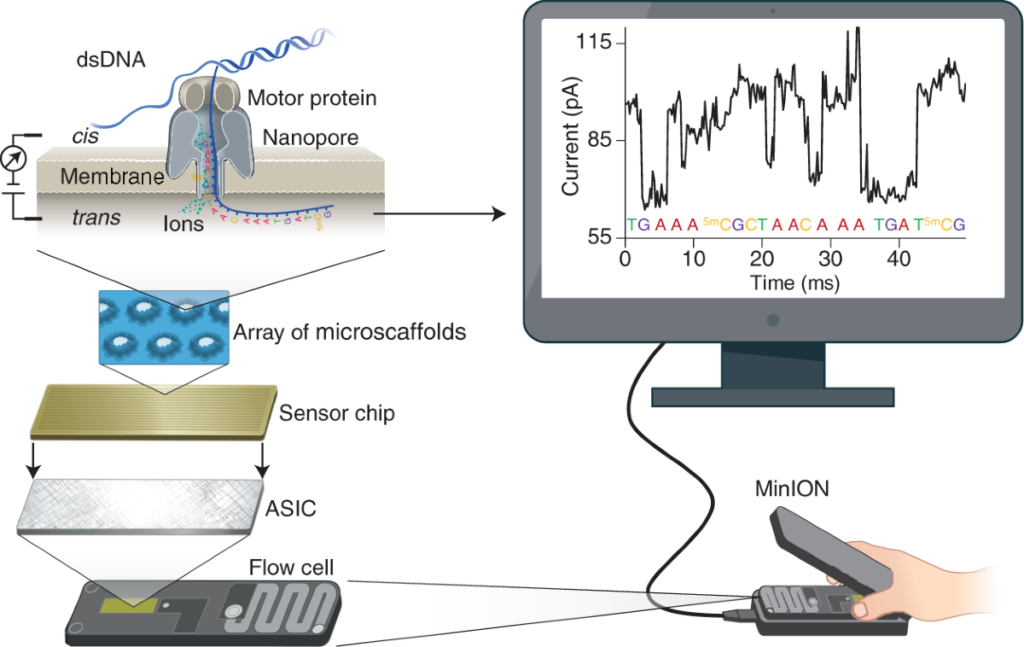
Nanospore sequencing. From Nature.
- Decoding
The DNA nucleotides from the sequencing are converted to binary code and are once again digitized.
Advantages
- Biodegradable
- Strong and dense
- Can contain lots of information
- Uses considerably fewer resources than electronic storage systems
Disadvantages
- High cost
- Very slow and inefficient
Sources
- https://pmc.ncbi.nlm.nih.gov/articles/PMC11362454/
- https://wyss.harvard.edu/technology/dna-data-storage/
- https://www.nationalgeographic.com/science/article/dna-data-storage-biotechnology
- https://www.nature.com/articles/s41587-021-01108-x
- https://www.sciencedirect.com/science/article/pii/S2001037025000297
