

What is Bioinformatics?
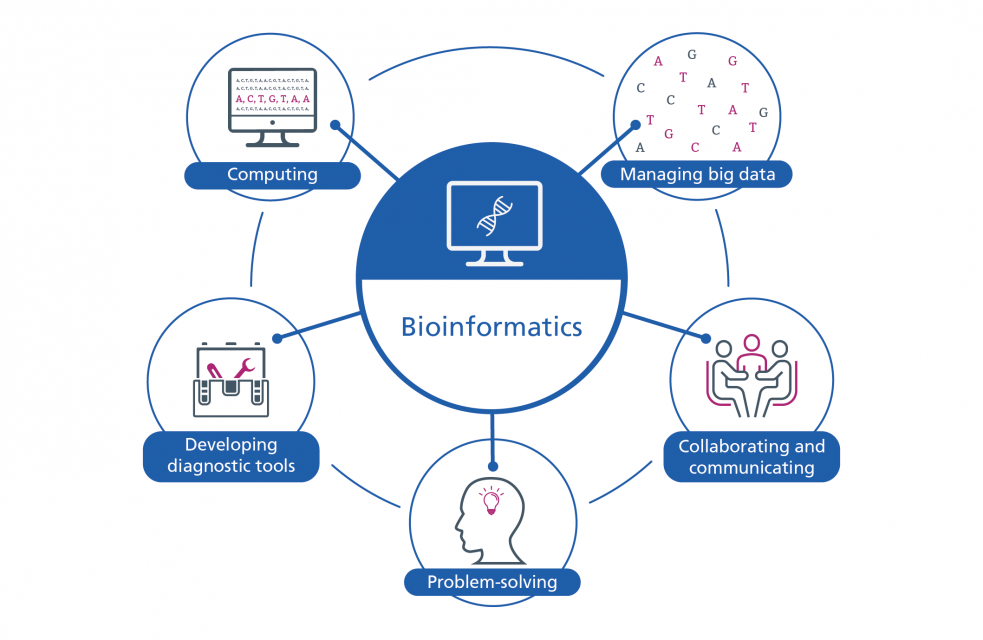
Bioinformatics is an emerging scientific subdiscipline that lies within the overlap of biology, statistics, and computer science. This process involves the use of computers in order to collect, store, and analyze biological data. With the use of these databases, biological information is organized and indexed in order to increase scientific understanding about certain fields in health and disease.
Careers in Bioinformatics
Bioinformatics Scientist: Develops software applications/databases in order to compile and subsequently analyze biological data. Closely associated with data science.
Research Scientist: Conducts research, typically in a laboratory setting, creating research involving both control and experimental groups. Having a background in bioinformatics helps with the interpretation of the results of experiments, and helps with applying discoveries to a broader field.
Biostatistician: Intersection of biology and statics. Focuses on the statistical design and analysis of biological research work.
Microbiologist: Involves the study of organisms such as bacteria and viruses. Having a background in bioinformatics allows researchers to interpret anomalies and patterns within the analyzed specimens, which can be applied to identifying areas of additional research and discovering cures to certain diseases.
Bioinformatician: Responsible for managing and analyzing large databases, developing frameworks, and creating algorithms in order to discover more about sets of biological data. Often collaborates with on-site scientists in order to interpret results of experiments.
Significance
Bioinformatics is an emerging subfield of science that is being increasingly used in problem solving. Solutions for scientific problems across all biological fields are arising from the development of bioinformatics, whether that means through the development of technology, or increases in analytical algorithms and databases.
Sources:
Popular Bioinformatics Careers
